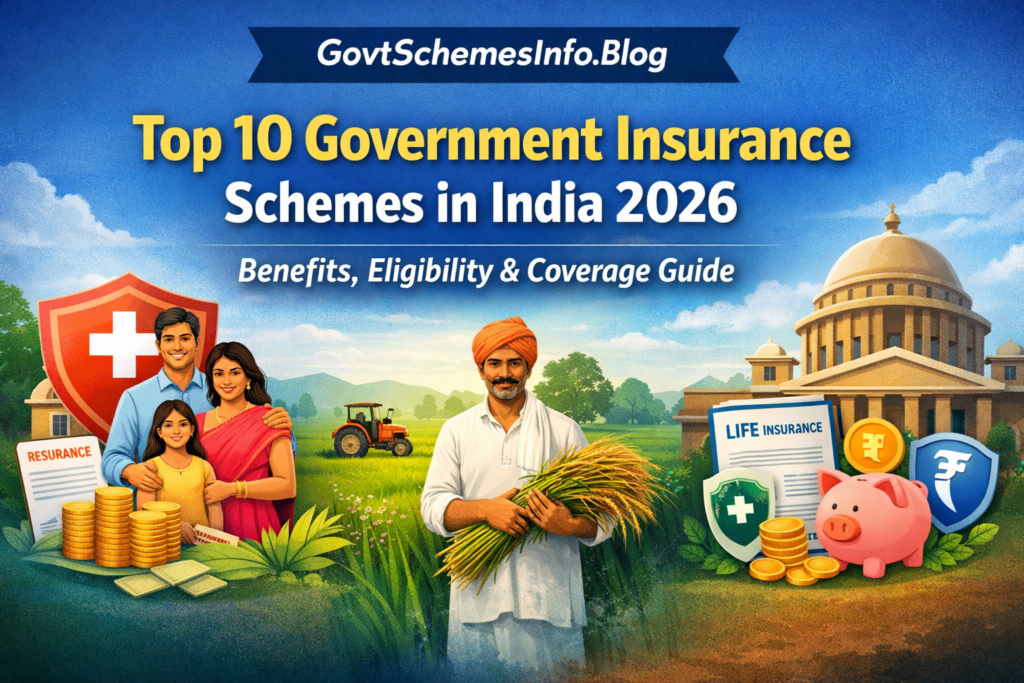
India has devised a powerful scheme of insurance and social security schemes that help the people to stay insured against health risks, economic instability and income deprivation. Low-income families, salaried workers and farmers, these state programs ensure financial insurance and social security to shareholders.
This guide includes 10 best government insurance plans in India (2026), covering, eligibility, and benefits with current updated information.
Health Insurance Schemes in India
1. Ayushman Bharat Pradhan Mantri Jan Arogya Yojana (PM-JAY)
It is a flagship program targeting families that are economically disadvantaged.

- Coverage: Up to ₹5 lakh per family per year.
- Benefits: Cashless treatment in empanelled public and private hospitals.
- Target Group: Bottom 40% of the population (according to SECC 2011 data)
- Key Feature: Reimburses secondary and tertiary hospitalisation cost.
It is also one of the biggest publicly funded health insurance programmes in the world.
2. Central Government Health Scheme (CGHS)
Comprehensive health program to its state employees.
- Coverage: OPD, specialist consultations, hospitalisation
- Benefits: Cashless treatment and reimbursement facilities
- Eligibility: Central government employees, pensioners, and dependents
3. Employees’ State Insurance Scheme (ESIS)
Multi-benefit social security of the employees in organised sectors.
- Coverage: Complete medical coverage to insured individuals and dependents.
- Benefits: Sickness, maternity, disablement, and dependent pensions.
- Eligibility: Employees earning less than prescribed wage limit.
Life & Accident Insurance Schemes
4. Pradhan Mantri Jeevan Jyoti Bima Yojana (PMJJBY)
Affordable life insurance to everyone.
- Coverage: ₹2 lakh (death due to any cause)
- Premium: Approx. ₹436 per year
- Eligibility: Individuals aged 18–50 years with a bank account
- Key Feature: Auto-debit facility for seamless renewal
5. Pradhan Mantri Suraksha Bima Yojana (PMSBY)
An accident insurance scheme at low cost.
- Coverage:
- ₹2 lakh (accidental death or full disability)
- ₹1 lakh (partial disability)
- Premium: ₹20 per year
- Eligibility: Individuals aged 18–70 years
6. Pradhan Mantri Jan Dhan Yojana (PMJDY) – Built-in Insurance
Mainly a financial inclusion plan with a benefit of an insurance.
- Coverage: ₹2 lakh accidental insurance (for eligible RuPay card holders)
- Additional Benefit: ₹30,000 life cover (conditions apply)
- Target: Unbanked and low-income households
7. Aam Aadmi Bima Yojana (AABY)
Social security scheme by the rural and unorganised sector workers.
- Coverage:
- ₹30,000 (natural death)
- ₹75,000 (accidental death or permanent disability)
- Additional Benefit: Scholarship for up to two children
- Target: Landless households and low-income earners
Specialised Insurance & Pension Schemes
8. Pradhan Mantri Fasal Bima Yojana (PMFBY)
An important scheme that helps farmers deal with losses of crops.
- Coverage: Crop failure due to natural calamities, pests, and diseases
- Premium: 1.5% to 5% (heavily subsidised)
- Eligibility: Farmers growing notified crops
- Key Feature: Wide coverage including food, oilseed, and horticultural crops
9. Atal Pension Yojana (APY)
A scheme to pension employees working in the unorganised sector.
- Benefits: Guaranteed monthly pension of ₹1,000 to ₹5,000 after 60 years
- Insurance Aspect: Spouse continues pension after subscriber’s death
- Eligibility: Individuals aged 18–40 years
10. Sukanya Samriddhi Yojana (SSY)
The girl child long-term savings scheme with financial security advantages.
- Purpose: Education and marriage expenses
- Benefits: High interest rate and tax exemption under Section 80C
- Eligibility: Parents/guardians of a girl child below 10 years
Why Government Insurance Schemes Matter
Insurance schemes, supported by the government, are crucial in:
- Relieving economic pressure in crisis situations.
- Offering affordable insurance to the poorer groups.
- Promoting financial inclusion and long-term savings.
- Helping farmers, workers, and vulnerable populations
The schemes are convenient and on hand with most of them being readily available in banks, mobile applications or government portals.
How to Apply for These Schemes
- Go to the nearest branch of a bank or Common Service Centre (CSC).
- Enroll with net banking or mobile banking applications.
- Check eligibility on official government websites.
- Keep essential documents ready (Aadhaar, bank account, income proof, etc.)
Conclusion
These insurance programs continue to assure that the social security network within the Indian government is getting stronger. These programs are health insurance under the name PM-JAY, financial insurance under the name PMJJBY and PMSBY, or the assistance of farmers under the name PMFBY, which will ensure the citizens will be more ready against the uncertainties.
The appropriate scheme being selected based on your requirements can have significant boost to your financial strength and security in life.
Frequently Asked Questions
1. Which is the best government health insurance scheme in India?
Ayushman Bharat Pradhan Mantri Jan Arogya Yojana (PM-JAY) is considered to be the best among the families with low income because it covers ₹5 lakh and gives an option of cashless treatment.
2. Can I enrol in multiple government insurance schemes?
Yes, eligible people could also enroll both Pradhan Mantri Jeevan Jyoti Bima Yojana (PMJJBY) and Pradhan Mantri Suraksha Bima Yojana (PMSBY).
3. Are these schemes available online?
Yes, all the schemes can be found through bank websites, mobile apps, or even on the government websites.
4. Is Aadhaar mandatory for enrolment?
Aadhaar is usually mandatory to identify and verify.
5. Which scheme is best for farmers?
Pradhan Mantri Fasal Bima Yojana (PMFBY) is created with an aim of protecting the farmers in case of losses of crops.