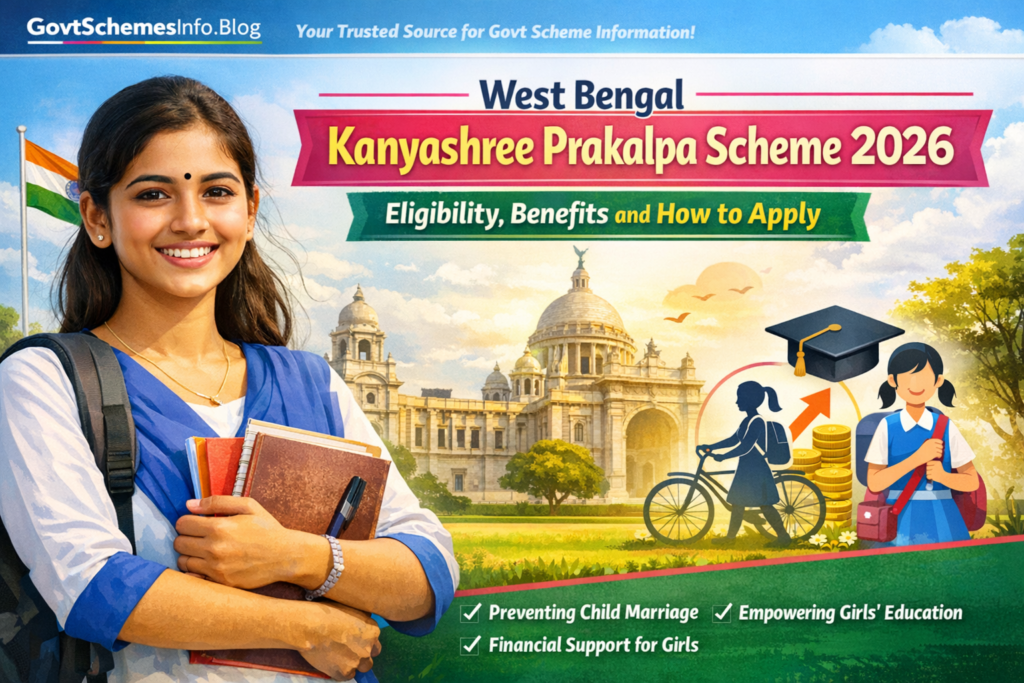
The Kanyashree Prakalpa Scheme is considered one of the most well-known social welfare programs in India focused on empowerment of adolescent girls by providing education and access to financial services. The scheme is introduced by the Government of West Bengal and is aimed at the prevention of child marriage, the desire to continue studying, and the enhancement of the future socio-economic outlook of the girls.
This article presents the most recent updated requirements as of 2026, such as eligibility requirements, benefits, application procedure, documents required, and common question and answers.
Overview of Kanyashree Prakalpa Scheme
The Kanyashree Prakalpa Scheme is introduced by the Department of Women Development and Social Welfare and Child Development to assist the girls of the economically disadvantaged families. The scheme works by provision of conditional cash transfers, as an incentive to girls to keep on with their education and to also not get married before the legal age of 18 years.
The financial aid is directly deposited in the bank account of the beneficiary leading to financial independence and inclusion and empowering girls to make informed choices about their education and future.
Objectives of the Scheme
The key objectives of the Kanyashree Prakalpa Scheme include:
- Encouraging girls to continue secondary, higher secondary, and higher education.
- Reducing instances of child marriage by incentivising unmarried status until adulthood.
- Improving health outcomes by reducing early pregnancies and associated risks.
- Promoting financial inclusion by transferring benefits directly to beneficiaries.
- Enhancing self-esteem and social empowerment through awareness programmes, competitions, and Kanyashree clubs.
Benefits Under Kanyashree Prakalpa
The scheme gives two categories of financial support:
1. Annual Scholarship (K1)
- Financial assistance of ₹1,000 per year.
- Applicable for girls aged between 13 and 18 years.
- The applicant must be studying in Class VIII or above.
- The benefit continues annually as long as the applicant remains unmarried and enrolled in education.
2. One-Time Grant (K2)
- A one-time grant of ₹25,000.
- Provided after the applicant turns 18 years old.
- The applicant must be engaged in education, vocational training, or an occupational pursuit and remain unmarried.
Eligibility Criteria
The applicants are required to meet the following requirements:
- Must be a resident of West Bengal.
- Must be enrolled and regularly attending a recognised educational institution.
- Must be unmarried.
- Annual family income should not exceed ₹1,20,000.
- Age requirement:
- K1: 13 to 18 years
- K2: 18 to 19 years
- Must have a bank account in her own name.
- The educational institution must be recognised and located in West Bengal.
Eligible Educational Institutions
Students of the following institutions are eligible as applicants:
- Schools, madrassahs, or open schooling programmes (Class VIII or above)
- Colleges or open universities
- Vocational, technical, or industrial training centres
- Sports institutes (eligible for K2 only)
Relaxation in Income Criteria
Income limits are relaxed for:
- Specially-abled girls with 40% or more disability
- Girls residing in homes registered under the Juvenile Justice Act, 2000
- Girls who have lost both parents
Application Process (Offline)
Step 1: Obtain Application Form
- Collect the K1 form (light green) for annual scholarship.
- Collect the K2 form (light blue) for one-time grant from the educational institution.
- Renewal and upgradation cases should be processed through the Head of Institution.
Step 2: Open a Bank Account
All the applicants should have a separate bank account. The government directly credits all its benefits into this account. Make sure that the name and application form are identical.
Step 3: Fill the Application Form
- Complete all details carefully.
- Ensure correct spelling of name and mobile number.
- Sign on all required pages.
- Seek assistance from teachers or institution authorities if required.
Step 4: Submit Required Documents
Attach photocopies of all necessary supporting documents.
Step 5: Collect Acknowledgement Receipt
Once submitted, receive the acknowledgement slip given by the institution. This acts as an evidence of application and it has the Form Number to track.
How to Track Application Status
After uploading the application on Kanyashree portal, the applicants will be able to monitor their status through the Form Number stated on the acknowledgement slip. When a student transfers to another institution, the former institution will be required to send the Kanyashree record online so that benefits may be continued.
Documents Required
- Birth Certificate (mandatory for K2)
- School record certification (acceptable for K1 if birth certificate unavailable initially)
- Declaration of unmarried status signed by parent or guardian
- Family Income Certificate (if applicable)
- Disability Certificate (for specially-abled applicants)
- Death certificates of parents (if applicable)
- Residence proof for Juvenile Justice Act home (if applicable)
- Bank passbook copy showing account details
Frequently Asked Questions
Who can apply for the Kanyashree Prakalpa Scheme?
The girls who are not yet married and living in West Bengal and are enrolled in the recognised institutions of learning or vocational training and meet the income requirements can apply.
Is there an age limit for the scheme?
Yes. K1 is for girls aged 13–18 years, while K2 is for girls aged 18–19 years.
Can students from madrassahs or open schools apply?
Yes, students attending recognised madrassahs or the open system of schooling are eligible.
Are girls studying in sports institutes eligible?
Girls in sports institutes also have access to the K2 grant one-time but not the K1 annual scholarship.
Do K1 beneficiaries need to apply every year?
Renewal is processed through the institution after verification of eligibility and unmarried status.
How to apply for K2 after turning 18?
Applicants who are eligible are required to get the K2 upgradation form in their respective institutions in case they are already enjoying K1 benefits.
Conclusion
The West Bengal Kanyashree Prakalpa Scheme has remained a major force in enhancing the education of girls, postponing early marriages and empowering girls economically thereby, empowering them economically. The scheme has been a trail of successful welfare programs, through the integration of financial aid and social empowerment, which uphold long term development and gender equality.
To get updated and to access the official guidelines, the applicants can always refer to their learning institution or use the official Kanyashree portal that has been maintained by the Government of West Bengal.