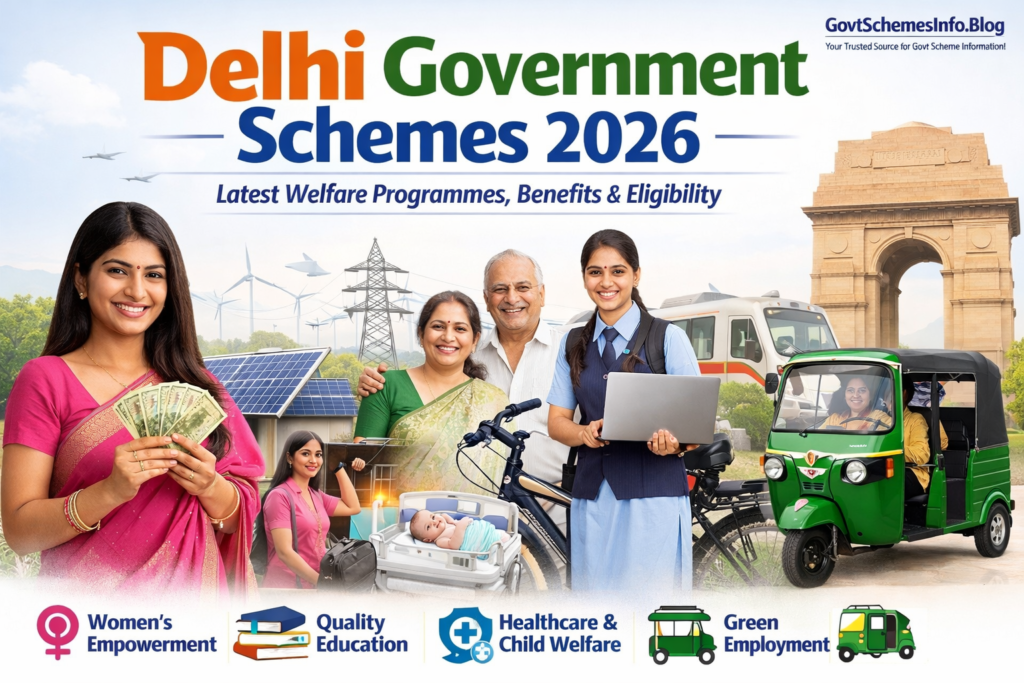
The Government of Delhi is continually enhancing its welfare system in 2026 with a keen interest in the empowerment of women, their education, health and sustainable development. The aims of the schemes are to enhance living standards of residents and to have an inclusive growth.
The following is an updated and detailed list of the best Delhi government schemes in 2026, their advantages, eligibility and main features.
1. Mahila Samriddhi Yojana
Among the most debated welfare schemes, it is a scheme that offers ₹2,500 per month to women of economically weaker classes who are eligible.

Key Benefits:
- Descartes Grants Direct Financing to Enhance Household Stability.
- Emphasise female-based economic autonomy.
- Mass distribution with broader scope.
Eligibility:
- Low-income women.
- Should satisfy income and residency requirements (to be informed about them officially)
2. Free Electricity & Water Subsidy Scheme
This ancient programme persists in 2026, which is a significant relief on utility bills.
Electricity Benefits:
- Up to 200 units: Zero bill
- 201–400 units: 50% subsidy (up to ₹800)
Water Benefits:
- Up to 20,000 litres per month free
- Needs to have a working water metre.
This programme costs middle- and low-income households a lot less to live.
3. Free Bus Travel Scheme (Pink Ticket)
Delhi is the only example with free transport to pre-women and transgender.
Highlights:
- On cluster buses and on DTC.
- Improves safety, movement, and human involvement in work.
- Widely used across the city
4. ANMOL Scheme (Advanced Newborn Healthcare)
ANMOL (Advanced Newborn Monitoring for Optimal Lifecare) programme is an important healthcare programme.
Key Features:
- Offers 56 newborn diagnostic tests at free levels.
- Early identification of children genetic and congenital diseases.
- Can be found in government and empanelled private hospitals.
This plan enhances health care in the neonatal department and decreases infant mortality rates.
5. Free LPG Cylinder Scheme
In an attempt to address increasing fuel prices, the government provides free twice a year LPG cylinders.
Benefits:
- One cylinder during Holi
- One cylinder during Diwali
- Helping ration card holders.
The move relieves low-income families.
6. Education Support Scheme (Bicycles & Laptops)
The welfare policies of Delhi focus on education.
Key Components:
Free Bicycles:
- In respect of Class IX girl students of government schools.
- Favours schooling and more school dropouts.
Free Laptops:
- On meritorious Class X students.
- Promotes e-learning and educational quality.
7. Delhi Lakhpati Bitiya Yojana
Girls financial security scheme at a long-term level.
Key Benefits:
- Deposits by government are not more than ₹61,000.
- Grows up to 1.2 lakh rupees.
- Favours edifying and provisioning.
This is a scheme that enhances the welfare and empowerment of the girl child.
8. Jai Bhim Mukhyamantri Pratibha Vikas Yojana
An intensely effective programme of competitive examination students.
Benefits:
- Free examination coaching like UPSC, JEE, NEET and banks.
- Pays school fees and boarding allowance.
Eligibility:
- Students of SC, ST, OBC, and EWS.
- Should fulfil the requirement of merit in academics.
9. Vayo Anand Yojana (Senior Citizen Welfare)
A new programme to improve the lives of the elderly.
Key Features:
- Social and recreational activities.
- Social networking sites.
- Attend to the mind and proactive ageing.
10. DURGA Scheme (Women & Transgender Employment)
The DURGA (Driving Upliftment and Rozgar to Women/Transgender Green e-Auto) initiative encourages the creation of livelihoods.
Highlights:
- Free e-auto permits
- First stage: 1,000 women and 100 transgenders beneficiaries.
- Favours green holistic and jobs.
Why These Schemes Matter in 2026
The welfare approach in Delhi is an indication of a movement towards:
- Financial inclusion with direct benefit transfers.
- Women empowering policies.
- Electric mobility is a sustainable initiative.
- Growth of education and healthcare.
All these plans are meant to deliver a more inclusive and progressive urban society.
How to Apply for Delhi Government Schemes
Although all schemes are different in their application procedures, the majority of schemes include the following steps:
- Go to the official web site of the government of Delhi.
- Sign up with Aadhaar and mobile number.
- Attach the necessary papers (income certificate, ID proof, etc.)
- Get an application done online or on specific centres.
Applicants should ensure that they see official notifications relating to scheme-related guidelines.
Conclusion
According to the best Delhi government schemes in 2026, there is an equal emphasis on welfare, both monetary, educational, medical, and sustainable. These initiatives have been dominant, with an ideal focus on inclusiveness and empowerment, but they remain the model of urban governance in India.
Frequently Asked Questions
Q1. Who can be eligible to Mahila Samriddhi Yojana?
Women belonging to weaker sections living in areas of Delhi can apply on income qualification.
Q2. Is the electricity absolutely free in Delhi?
Yes, up to 200 units per month. More than that, there are subsidies according to consumption.
Q3. Does ANMOL include any private hospitals?
This is yes, there is selection of private hospitals, which falls under the scheme.
Q4. What do students do to apply to free laptops?
Through their schools, eligible students are selected based on their academic performance.
Q5. What is the aim of the DURGA scheme?
It seeks to offer job opportunities to women and transgender people via e-auto licences.